
Are you tired of your rental?
I have this conversation with longtime landlords more often than you'd think. The property made sense when you bought it. Maybe it still cash flows. But lately it feels like more headache than investment, and there's a reason for that. Properties age, neighborhoods change, and tax benefits run out.
If any of these sound familiar, a 1031 exchange is worth a serious look. It's the part of the tax code that lets you sell an investment property and roll the proceeds into a new one, deferring the capital gains tax you'd otherwise pay on the sale. Here's why people do it.
First, you are tired of the repairs. Older rentals ask for more. Roofs, plumbing, appliances, tenant calls at the worst times. An exchange lets you trade that older, maintenance-heavy property for something newer, where the big-ticket repair costs are years away instead of right around the corner.
Second, the neighborhood has changed. Maybe you bought in an area that has already had its big run, and you want to bank on the appreciation you've earned instead of hoping for more of the same. Or the area has headed in a direction you didn't sign up for. Either way, selling outright means handing a big chunk of your equity to taxes. Exchanging lets you move the full amount, before tax, into a property and a neighborhood you like better for the next chapter.
Third, you are running out of depreciation. If you've held a rental for a long time, you may have used up most of the depreciation that has been sheltering your rental income year after year. Once that benefit fades, the same rent check gets a lot more taxable. Moving into a new property, especially when you're adding new money or buying up in value, can restart that conversation. Your CPA can map out exactly how it works in your situation.
I saw this play out with a client in North San Jose not long ago. They had held their rental for more than 10 years, we prepped it and brought it to market ahead of the competing listings, and it sold for 22% above asking. Instead of cashing out and taking the tax hit, they rolled the proceeds into their next investment property through a 1031 exchange. Same equity, still fully invested, just working in a better property.
The Bottom Line on How It Works
A few rules decide whether an exchange succeeds, and they are worth knowing before you list:
- Both properties have to be real property held for investment or business use. They do not have to be the same kind of property. You can exchange raw land for an apartment building.
- You cannot touch the money. A qualified intermediary holds the sale proceeds until they go into your replacement property.
- You have 45 days from the close of your sale to identify your replacement property in writing. Most people use the 3-property rule: identify up to three properties, no matter their value.
- You have 180 days from that same closing to complete the purchase (or until your tax return due date with extensions, whichever comes first).
- To defer all of the tax, buy replacement property of equal or greater value, reinvest all of your net equity, and replace the debt you paid off, or make up the difference with cash. Buy for less, and part of the exchange can become taxable.
- The same taxpayer who sells has to buy. One common workaround: a single-member LLC is disregarded for tax purposes, so buying through one can still qualify.
Five Tips for a Smooth Exchange
- Sign the exchange documents before you close. The exchange agreement, the assignment of your sale contract, and notice to your buyer all need to be in place on or before closing day. This is the step people miss, and it cannot be fixed after the fact.
- Decide early who will take title to the replacement property, especially if a lender wants a single-asset entity involved.
- Do the math on buying enough property. Sell for $1 million with a $300,000 loan, and a full deferral means a replacement worth at least $1 million, with your full $700,000 of equity going back in.
- Watch the small expenses. Commissions, escrow fees, exchange fees, and transfer taxes can usually be paid from exchange funds. Credits to your buyer for things like security deposits or prepaid rent generally cannot, so plan to cover those out of pocket if you want to avoid a partial tax bill.
- Ask how your money is being held. Your funds sit with the intermediary during the exchange. Ask whether they are in a separate account under your name and tax ID, in an FDIC-insured account, and how financially strong the intermediary is.
The biggest takeaway: a 1031 exchange is planned before the sale, not after. If you are tired of your rental and thinking about a trade up, the time to talk is before you list, while every option is still open. I'm always happy to run the numbers with you and connect you with a qualified intermediary and your tax advisor early, because this article is general information, not tax or legal advice, and your own situation decides whether an exchange pencils out.
Source material: First American Exchange (Lisa Villarreal, 408.470.9417, lvillarreal@firstam.com, firstexchange.com)
Market Nuggets
For this month, I'm going to zoom in on Walnut Creek to give you a micro market insight. Here's what October looked like for single-family homes.
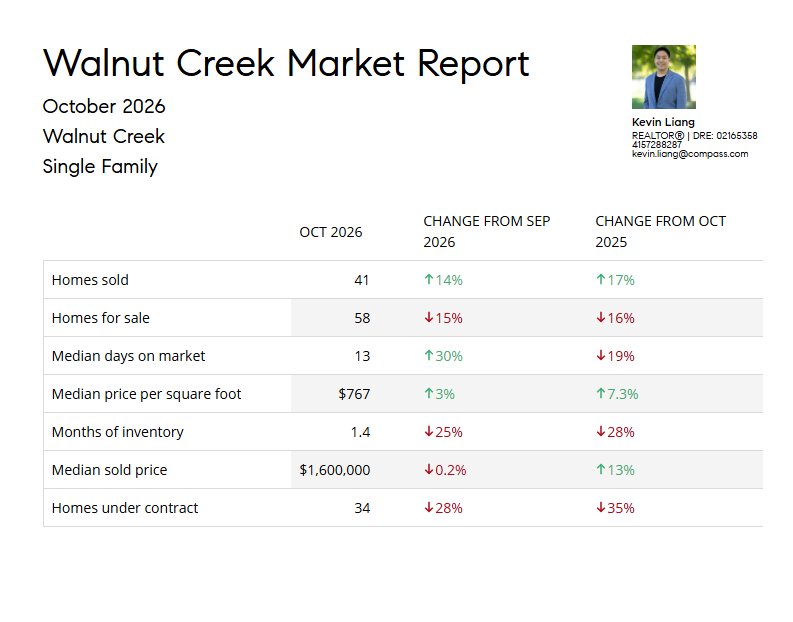
Inventory tightened even further. Just 58 homes for sale, down 16% from last October, which works out to only 1.4 months of supply, down 25% from September. When supply is that thin, buyers simply do not have many choices.
Sales actually picked up. 41 homes sold in October, up 14% from September and up 17% from a year ago. Homes took a median of 13 days to sell, a little slower than September's quick 10 days, but still faster than last October.
Prices held steady. The median sold price was $1,600,000, basically flat from September (down just 0.2%) but up 13% from a year ago. Price per square foot climbed to $767, up 3% from September and up 7.3% year over year.
The number to watch: only 34 homes went under contract in October, down 28% from September and down 35% from a year ago. Closed sales were strong, but the pipeline of new deals slowed heading into the holidays.
The bottom line: Walnut Creek single-family is still leaning toward sellers on supply and price, but with fewer homes going under contract, this fall market is getting more selective.
Events, Recipes & Health Tips
Events
50th Annual Lighting of the Old Oak Tree — Friday, November 27, 5:00 to 8:00 PM, Downtown Danville. Continue the Thanksgiving weekend with one of Danville's most beloved traditions. Celebrate the 50th anniversary of the Old Oak Tree Lighting with holiday music, performances by local choirs, and appearances by Father Christmas and the Snow Angel, followed by a festive procession through downtown Danville.
Walnut Creek Turkey Trot — Thursday, November 26, 8:00 to 11:00 AM, Civic Park, 1375 Civic Drive. One of Walnut Creek's favorite Thanksgiving traditions returns to Civic Park with 5K and 10K races, children's fun runs, and a festive costume contest. Proceeds benefit White Pony Express, Pledge to Humanity, and the Forma Kids Foundation.
For the Foodies
Ganache Brownie Cake. A rich, fudgy brownie base topped with silky chocolate ganache. A bakery-quality centerpiece dessert for chocolate lovers, and a strong addition to any holiday table.
Health Tips
Megan Thee Stallion's go-to glute exercise. A Pilates-based glute exercise that requires zero equipment, so it works just as well in a living room as in a gym.
Best soups for blood pressure. Soup season is here. If you are watching your blood pressure, the ingredients in the bowl matter: look for fiber and potassium, and keep an eye on sodium.